Stilt walking is part of a folk tradition of performances, rooted in Taoism, that have been used to mark festivals and celebrate local deities for hundreds of years. These rituals of pilgrimage and prayer were effectively banned in China during the Cultural Revolution of the 1960s and 70s, when Mao Zedong, encouraged militant student “red guards” to eradicate “old culture” and superstition. A grassroot revival of these traditions can now be witnessed throughout China. A phenomenon that has been helped by Beijing’s efforts to encourage — and control — traditional art forms and spiritual practices as part of Xi Jinping’s push for “cultural confidence.”
In Shengfang, a small city two hours drive South of Beijing, dozens of volunteer-run associations are now reviving many of these suppressed traditions and passing them on to a new generation.

On the outskirts of Beijing, for a Taoist festival, members of Shengfang Xiaohexi Tongyi stilt-walking club perform in front of enthusiastic pilgrims, to honor Bixia the goddess of fertility. All of them are volunteers, who since their childhood, have been training countless hours to master the art of stilt-walking.

Members of the Xiaohexi Tongyi stilt-walking club apply makeup, at the group headquarters before heading to a performance. As much as stilt-walking itself, an elaborate make-up is key to the quality of the show, and requires days of training.

A used-car salesman is transforming himself into a rosy-cheeked matron — a comedic cross-gender role known as the “foolish mother.”

Volunteers of the Shengfang Xiaohexi Tongyi stilt-walking club : Yu Meijie, a 22 years old wedding photographer, Wang Song a 26 years old, dessert cook, Gas Jian, a18 years old, student, Wang Wei, a 22 years old, cloth shop salesman, with Bai Xinze, 5 years old, his apprentice.

Before departing for Tianjin, where they will perform to honor Mazu, the goddess of the sea, the troupe takes turn kneeling before a shrine to Zhurong, the god of fire, to pray for safety.

A volunteer, usually working as a used-car salesman, has transformed himself into a rosy-cheeked matron -a comedic cross-gender role known as the “foolish mother”- and his heading to the bus that will take the troupe for a performance in honor of Mazu the goddess of the sea.

Liu Ning, a local influencer who has joined the troupe in drag, chatting with other members of the troupe, on the bus taking them to the Mazu festival. The Xiaohexi Tongyi stilt walkers attribute their popularity to blending traditional folk tales with acrobatics and a dose of slapstick comedy, drawing on a long history of cross-gender acting and improvisation in Chinese folk performances.

Members of the Xiaohexi Tongyi stilt-walking club head to a makeshift temple set-up to honor the goddess Mazu

In a suburb of Tianjin, pilgrims bring statues of Mazu, the sea goddess, to a makeshift temple erected for the celebration of her birthday.

People pray at a makeshift temple set up in celebration of Mazu’s birthday, if front of which the Shengfang troupe will perform.

Guo Wenmiao (centre), a 20-year-old engineering undergraduate, with other members of the troupe, waiting to perform, at the Mazu festival.

The club performs an act that combines folksy storytelling and freewheeling performances with spiritual undertones.

During the Mazu celebration, members of the Xiaohexi Tongyi stilt-walking club performing the move called “riding the camel”. The performers are amateurs, but they know how to put on a show.

Guo Wenmiao, a 20-year-old engineering undergraduate a foppish princeling who becomes obsessed with catching an evasive butterfly, at the Mazu celebration in Tianjin. “I have loved folk culture since I was a child,” he says, a sentiment shared by his fellow stilt walkers. He has dreams of getting a master’s degree from a prestigious military academy and securing a coveted job as a government official in a big city. But he considers stilt walking, which he took up when he was barely in his teens, his true passion.

A performer taking off the stilts, before getting on the bus heading back to Shengfang.

After a performance for a funeral, in Shengfang, performers are heading back to the troupe headquarters, at the back of a three-wheel cart.

After a show at a funeral, the young performers share a dinner at a restaurant.

Guo, the butterfly chaser, heading back home with fellow stilt walkers.

Guo, the butterfly chaser, and a fan of the NBA, on his bed at the family home. He met his older doctor girlfriend in a chance encounter when he was performing in Tianjin, where she lives.
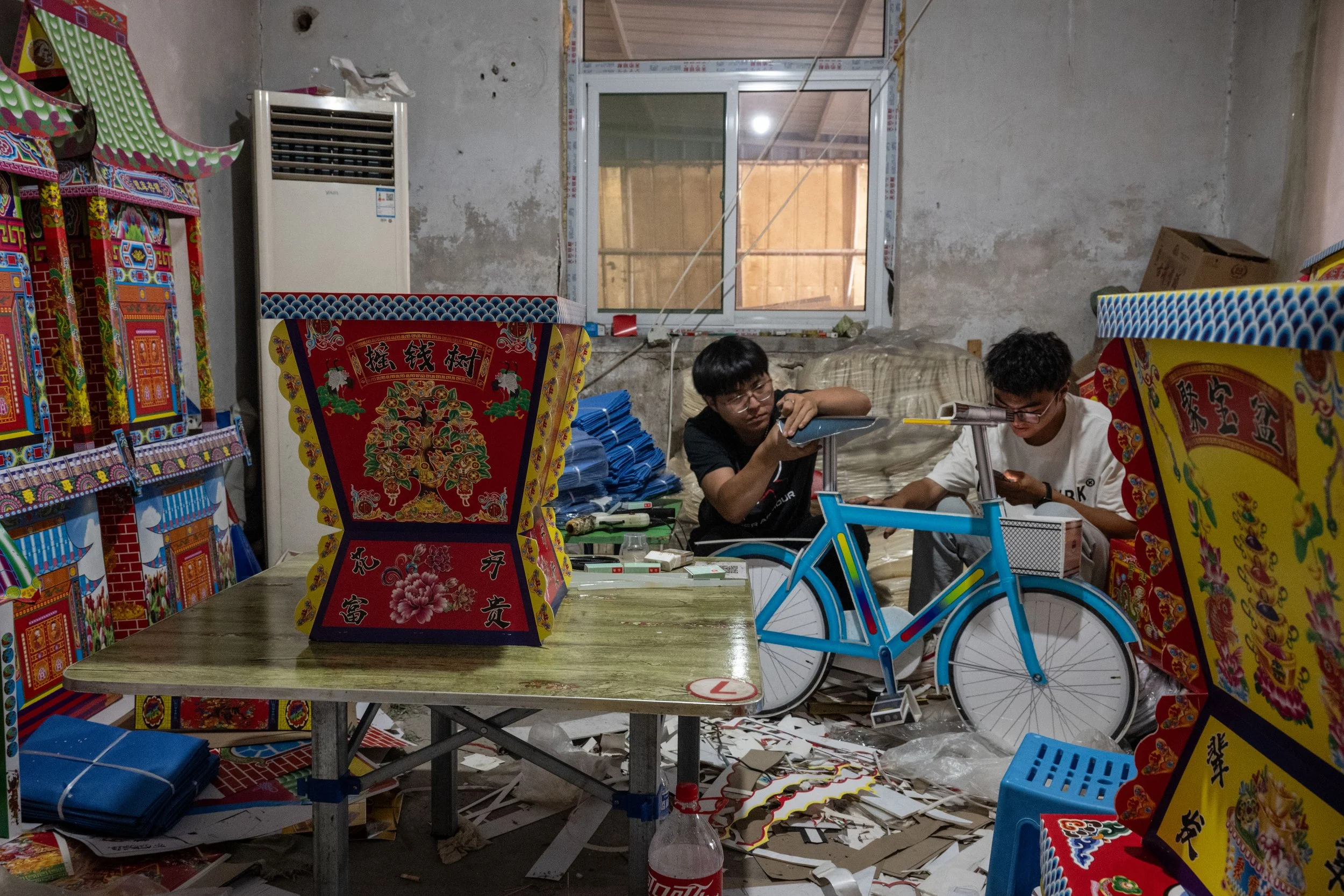
Guo Tongkai, the 23-year-old lead performer, of the troupe with Guo Wenmiao, creating paper objects to be burned at funerals. Guo Tongkai job is a funeral business : building coffins and creating these paper objects, a Daoist tradition. “Joining the troupe is something that’s ingrained in everyone. It has nothing to do with business,”. Many of the performers began stilt walking when in primary school and regard themselves as “disciples” of the art form. “It’s a tradition passed down from our ancestors,” says Guo Tongkai, who started learning to walk on stilts at the age of 5. “Everyone progresses and learns together.”

Liu Bowei, 23, took up stilt walking for several reasons: It offered something to do outside making and selling laundry detergent for his family business. It also, like the tattoos on his forearms, is “just a hobby — a kind of self-expression.”

A propaganda billoard for the CPC, at a temple where the troupe is performing. “There is an effort by the government to cloak itself in legitimacy by presenting itself as a protector of traditional values,” said Ian Johnson, author of “The Souls of China: The Return of Religion After Mao.” But the revival is driven primarily by grassroots enthusiasm. “A lot of these troupes suffered for many, many decades when they were considered backward culture. The revival has been pushed by people from below,” he said.
