China is a country of superlatives, and its railway network is no exception to the rule: the fastest, the longest, the highest, the most indebted… It is a source of National pride as well as a propaganda tool, testimony to the country’s efficiency and technological prowess. Beyond the superlatives, this rail network is also a reflection of China’s facets: green slow trains filled with farmers and migrant workers ride alongside fast white trains connecting smart cities. The revolution which started 15 years ago with the first high-speed railway line is still on-going, with an additional 25 000 km of high-speed routes planned for the next 10 years, connecting the most remote corners of the country, sometime duplicating existing routes.
This photo essay takes us on a train ride across China taking a measure of this train revolution.
A corridor of Beijing West railway station, a few days before the Lunar New Year. This station, the largest in Asia when it was inaugurated in the late 90s, is no longer adapted to China’s railways modernization. It mainly serves green (slow) trains, and a few high speed trains.
At Beijing West Railway station, a migrant worker is heading back to the family hometown for the New Year holidays. The Lunar New Year is the busiest time of year for train travels, with an estimated 190 million trips were during the 2024 spring festival holidays. China Railway network modernisation has made this yearly migration a lot easier, reducing it to a few hours when it could take 1 or 2 days just a decade earlier.
A few days ahead of the celebrations of the Lunar New Year, passengers aboard a green train settle into their quarters in the hard-sleepers section, carrying with them presents intended for their family. The traditional green trains continue to enjoy widespread popularity among travelers, despite their slow pace: tickets are considerably cheaper than the high-speed white trains, and provide overnight journeys across the country.
A passenger sleeping on the middle berth of a hard-sleeper green train.
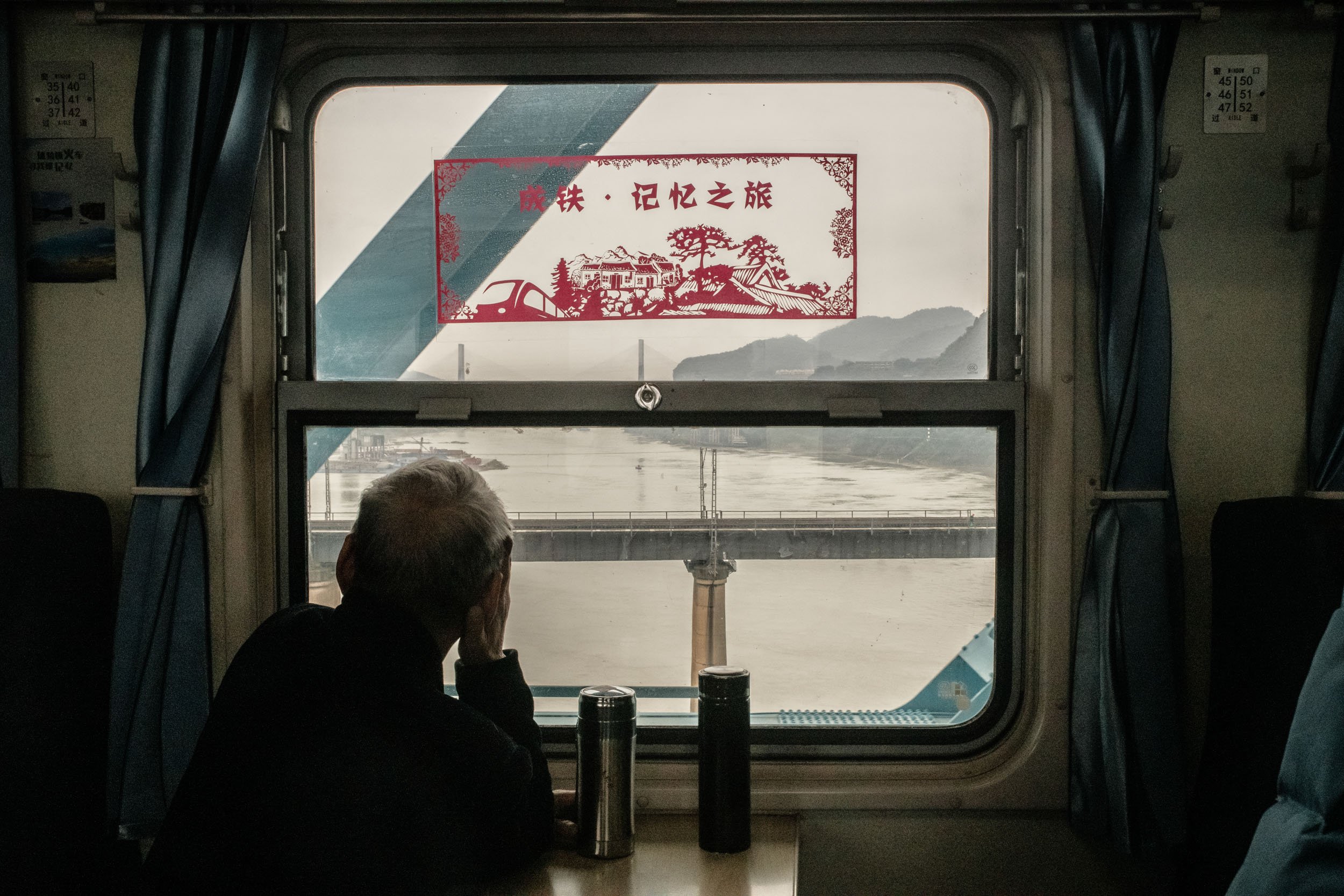
A passenger looking at the window while the green train is crossing the Yangtze river.
A passenger of a green train is having a cigarette at one end of the wagon. Smoking is permitted on the slower green train, but prohibited in the high-speed white trains.
A passenger is pouring boiling water on a bowl of instant noodles, a fixture of the China train traveler diet. Both high speed and slow trains have water boilers installed in every wagons.
Two passengers enjoying a meal on a slow train.
The view of the construction site for a high-speed train line, seen from a slow “green train” traveling across Guizhou province. The mountainous terrain of Southern China makes the construction of a high-speed train network there, extremely costly and technologically challenging. Local governments, already heavily indebted, are often required to partake in the costs of these new infrastructures.
Above Yunnan semi-tropical forest, close to the border, workers are building the China-Lao high-speed railway line. The line started operating in 2022. An extension of the line to Bangkok, is under construction. The Kunming-Vientiane railway is a link in a possible future network connecting China with Thailand, Vietnam, Myanmar, Malaysia and Singapore giving southern China more access to ports and export markets.
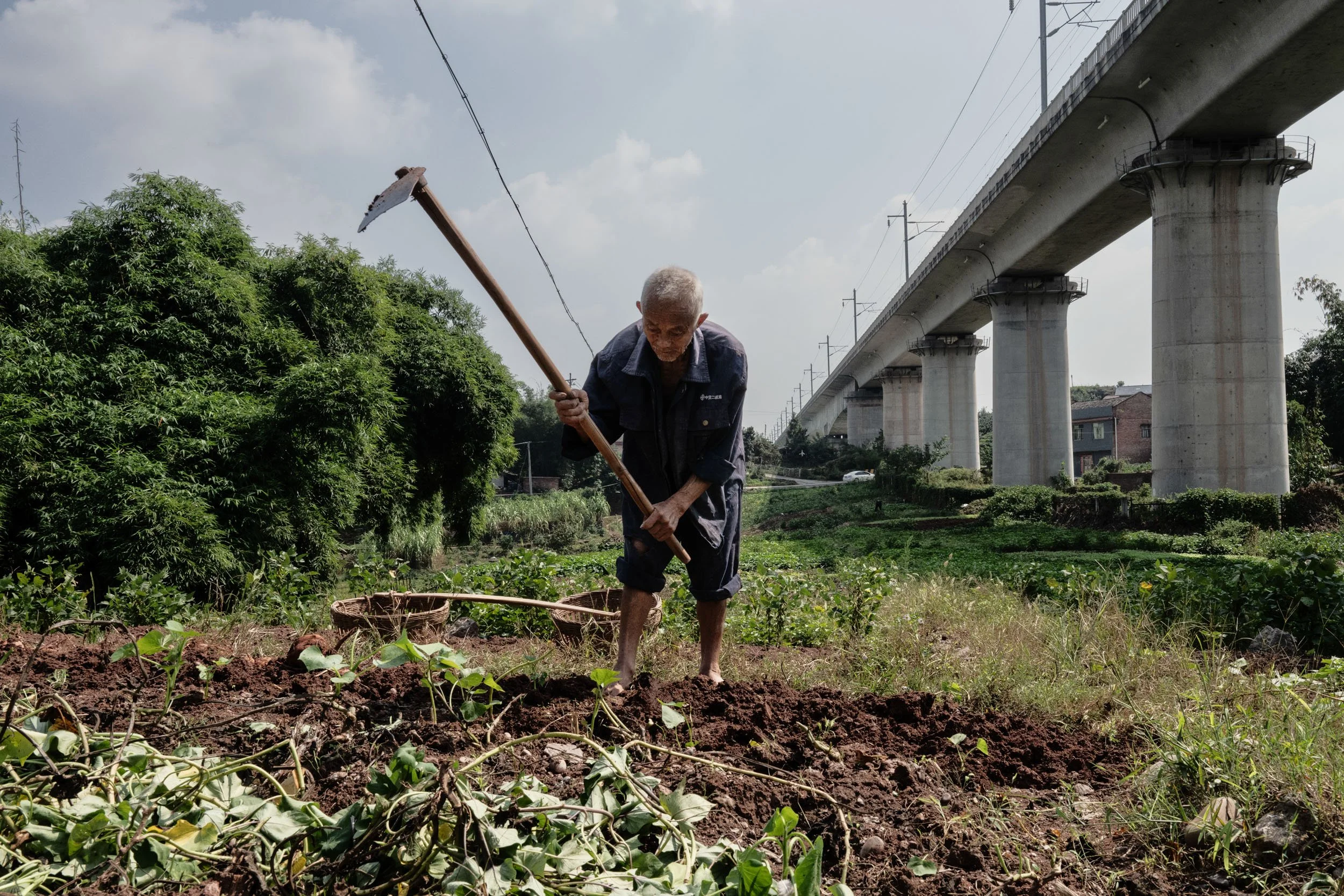
In Sichuan province, an aged farmer digging a sweet potatoes field, beneath a high-speed railway line opened to traffic in 2024. The high-speed railway network is now reaching once remote areas of the country. The economic benefits are not always obvious. Critics says that the country is now over-spending on infrastructures, while education or healthcare are still lagging behind.
A high speed train riding through a new neighborhood of Yibin (Sichuan) where a large real estate project, “The City Of The Future” is under construction. The opening of a new high speed train line, often triggers the construction of new neighborhoods. Building trains offers an immediate boost to an economy struggling to keep people employed. The hoped for, economic boom associated with the fast train, doesn’t always come, though.
A woman walking outside the empty Fushun railway station plaza where a Communist propaganda sculpture is on display. China high-speed railway network is a source of National pride as well as a symbol of the country’s economic development and technological prowess.
The V.I.P. salon of Chengdu Tianyu railway station, decorated with a large painting showing a high-speed train riding through Sichuan mountainous landscape.
A traveler in the cavernous and very empty waiting room of Yibin railway station, inaugurated in 2024, along with the Chengdu-Yibin railway line. This station counts only 2000 passengers a day, a low traffic : the city of 2 million, now counts 3 railway stations.
At Beijing South railway station, passengers waiting in line to access the platform of departing high-speed train. The station serves the Beijing-Shanghai high-speed line, inaugurated in 2011, and China’s rail network busiest with over 50 million passengers in 2023, generating a profit in billions of dollars..
A security agent screens passengers' luggage at Chengdu Tianfu high-speed railway station. The security protocol at railway stations in China is similar to that of airports, with all luggage being X-rayed and passengers going through metal detectors.
Passengers using their ID cards to get through a face-recognition system allowing them to access the train platforms. Material tickets have become obsolete on the Chinese rail network. Tickets are linked to ID numbers. This heightened security system allows a better population control.
At Weiyuan (Sichuan) high speed railway station, an employee using a loudspeaker to call passengers to speed up boarding the train.
A train employee pushing a food cart in the aisle of a second class high-speed train wagon. Food can be purchased on-line from the dining carriage or through trolleys that move through the train.
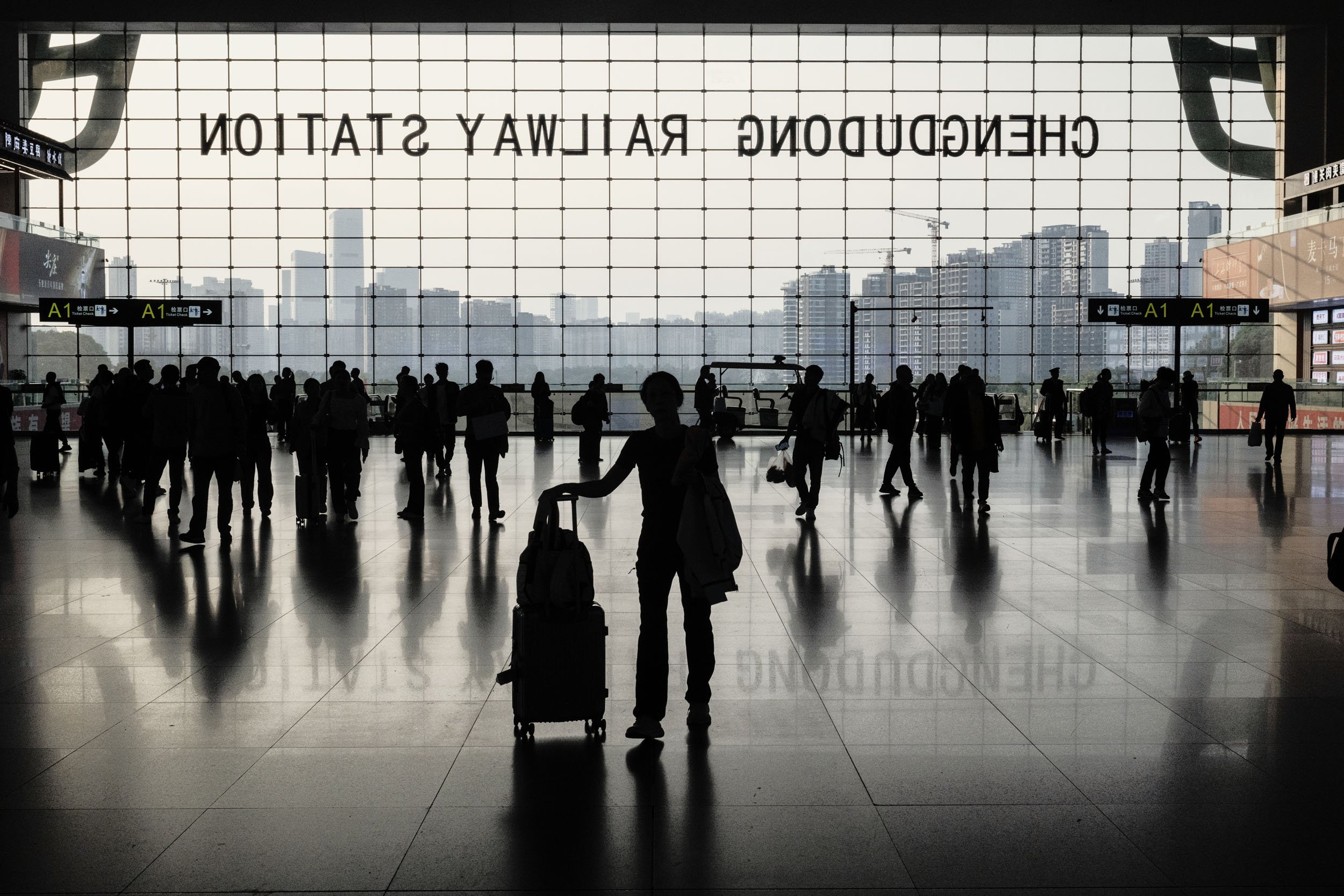
Passengers at Chengdu East Railway station, a regional hub for rail transport that sees millions of passengers a year.
A passenger in the empty waiting room of Yibin railway station. The country's geography has been transformed by China’s rail network. Futuristically designed railway stations have cropped up everywhere. They are not always full, sometimes empty, but Chinese people have seen that high-speed rail is changing their lives. In the 16 years since its inception, the high-speed train has become a symbol of the Chinese model.